1D and 3D Forward Modeling and Inversion of Clay Minerals: The Role of NEWMOD and WILDFIRE in X-Ray Diffraction
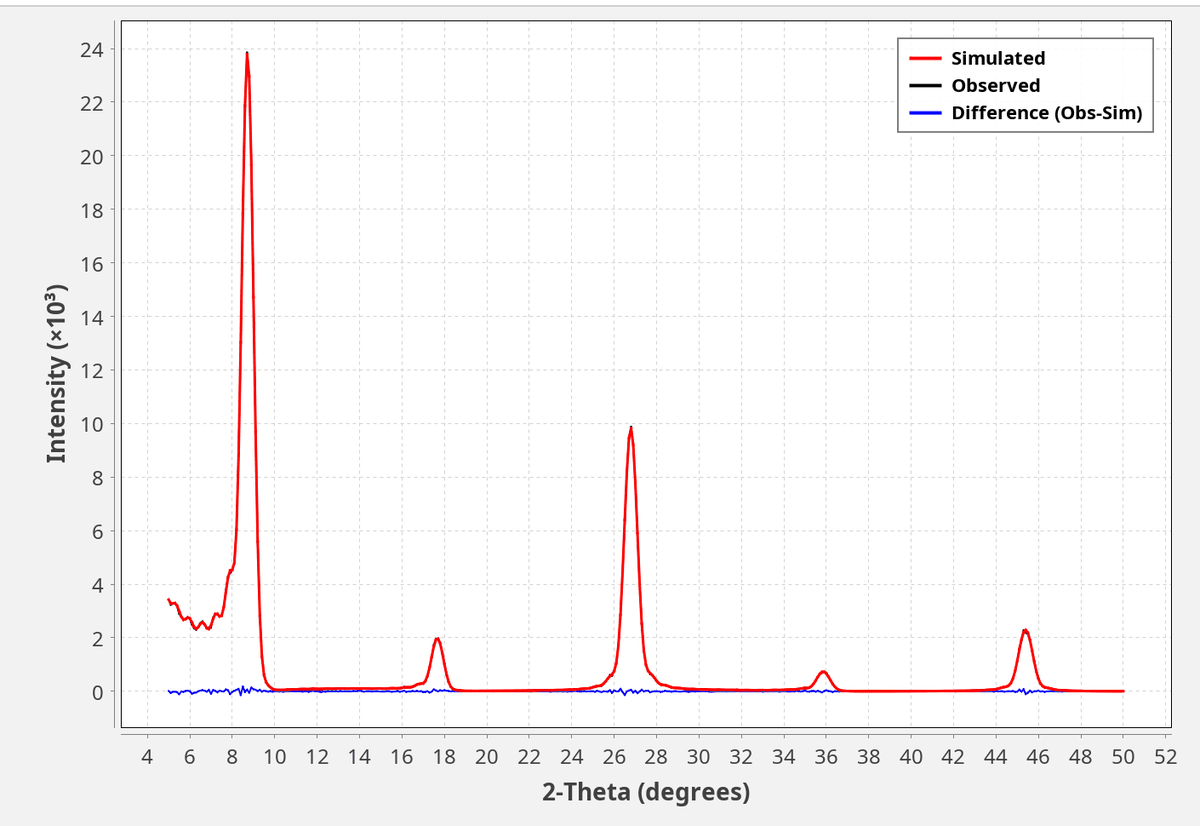
X-ray diffraction patterns of mixed-layer clays have broad, overlapping peaks that do not fall in a regular series, so they cannot be read from lookup tables alone. Newmod III and WildFire work the other way round: they calculate the pattern from the physical structure of the clay layers and fit it to your measured trace, so you can identify and quantify what is actually in the sample.
Both programs continue the work of Robert C. Reynolds, Jr., who wrote the original NEWMOD and WILDFIRE.
Newmod III
Calculates the one-dimensional (00l) pattern of an oriented clay mount, where the plate-shaped crystals lie flat on the slide, and fits it to your data.
- Layer proportions and expandability. Choose the layer types, such as illite and glycolated smectite, and their proportions to reproduce the peak migration between air-dried and glycolated states.
- Stacking order (Reichweite). Random (R0) to ordered (R1, R2, R3) interstratification, which gives the irrational 00l peak series of mixed-layer clays.
- Chemistry and crystallite size. Octahedral iron, interlayer potassium and the crystallite thickness set the peak intensities and breadths. Fit one model, or a mixture of up to four phases.
WildFire
Calculates the three-dimensional (hkl) powder pattern of randomly oriented mica, illite, illite/smectite and chlorite. Where Newmod III looks only along the stacking direction, WildFire also follows how the layers sit in their own plane.
- Rotational stacking disorder. Rotations between neighbouring layers, from the ordered 1M structure to fully disordered 1Md, smear the hkl reflections into broad bands. WildFire integrates the intensity through reciprocal space to reproduce them.
- Polytypes. Mica polytypes (1M, 1Md, 2M1, 3T) and chlorite polytypes. Separating detrital, high-temperature 2M1 mica from diagenetic 1M/1Md illite matters for burial diagenesis, thermal history and illite K–Ar and Ar–Ar dating.
Which program do I need?
| Newmod III | WildFire | |
|---|---|---|
| Sample mount | Oriented aggregate | Randomly oriented powder |
| Reflections | Basal 00l, along the stacking direction | Three-dimensional hkl |
| What it determines | Layer proportions (% smectite), Reichweite, chemistry (Fe, K), crystallite size | Mica and illite polytypes (1M, 1Md, 2M1), chlorite polytypes, rotational disorder |
| Main use | Swelling behavior, mixed-layer ratios and the amount of each phase | Detrital versus diagenetic origin, and how disordered the stacking is |
Why model instead of matching peaks?
Quantitative answers
Fitting returns numbers: layer proportions, ordering, composition, crystallite size and, for mixtures, the relative amount of each phase, each with its uncertainty.
Built on established theory
The calculations follow the published methods used in clay mineralogy for decades, with a choice of calculation engine. Read about the science.